The Hidden Profits of TikTok Shop: The Halo Effect and the Meta Flywheel

Every TikTok Shop P&L lies in the same direction: it undersells the channel. Shop GMV is the only number the platform hands you, so it becomes the only number in the review deck, and the review deck misses where most of the money actually lands. Discovery happens on TikTok. The purchase lands everywhere: Amazon, your site, Walmart, the shelf.
We say it plainly to every enterprise brand we work with: TikTok Shop pays for itself twice. Once in the shop, and again in the channels your attribution never connects to it. This playbook covers the two places the second payment shows up, the Halo Effect and the Meta flywheel, and gives you a calculator to size both for your own brand.
The Halo Effect
Search any viral TikTok product on Amazon and watch the autocomplete. Thousands of people are typing the exact product name, because they discovered it in the feed and went to buy it where they already shop. That behavior is the halo: TikTok creates the demand, other channels harvest it, and nothing in your dashboards draws the line between the two.
Most brands treat the halo as a story. We measured it.
Singles To Go launched Dunkin' Refreshers on TikTok Shop in February 2026. For 24 weeks we tracked Amazon sales against a sibling product in the same portfolio and storefront with zero TikTok activity, so seasonality and Amazon-wide swings were netted out by design. What the control showed:
Every million TikTok impressions returned about $17,800 in incremental Amazon revenue. The average Amazon week went from $41,332 before TikTok Shop to $161,703 after, and held there for 19 straight weeks. Over Prime Day's trailing 48 hours the product moved 66,735 units while the control moved 100, and it finished Top 5 in all of Amazon Grocery and Gourmet. Controlling for seasonality, we estimate roughly $1.02 million in incremental Amazon revenue from that single listing in the first half of the year, and about $2.6 million across the whole shop for the fiscal year.
And the ad spend paid for itself first: $99,399 in ads returned $463,047 in TikTok Shop GMV before a dollar of Amazon was counted. The halo was the bonus on top of a channel that already worked.
One thing the study taught us: awareness compounds. A spike in impressions this week does not spike Amazon this week. Months of presence move the baseline, and the baseline stays moved. Brands that judge the halo on a weekly dashboard will conclude it does not exist, then wonder why Amazon velocity climbed all year.
How to measure your own halo
The first question every CFO asks is whether the halo is actually measurable or just an agency story. It is measurable, at four levels of rigor, and you can start at the bottom this week.
Level one is a spreadsheet. Line up weekly TikTok impressions and GMV against your Amazon search term volume and Amazon sales, and watch the branded search line move.
Level two is already inside your seller dashboard. TikTok Seller Center now breaks out off-site conversions, measured through the TikTok pixel, so you can see which videos are driving purchases beyond the shop. One warning from running this across our book: the videos that convert hardest off-site often show near-zero shop GMV, because they never mention the orange cart. Judge them by the off-site column, or you will cut your best halo drivers for "not converting."
Level three is connected tooling. Our creator platform plugs directly into Amazon, correlating TikTok Shop activity against Amazon sales creator by creator, so the halo is tracked continuously instead of studied once a quarter.
Level four is dedicated cross-channel measurement. Platforms like Fospha run daily media mix modeling across every channel and marketplace and measure the halo directly. Their published cross-brand data lands where our control study did: counting Amazon sales lifts TikTok's measured ROAS by 33 percent and TikTok Shop's by 20 percent, while last-click attribution captures just 1.9 percent of TikTok's impact. Their modeling also finds half of TikTok conversions come from new customers, which is the halo's other face: this channel creates demand, it does not just harvest yours. TikTok has comped qualifying ad spenders months of Fospha access; ask your rep before you buy anything.
Whatever level you run at, four rules keep the read honest.
Pick a control. The whole trick of the Dunkin' study was a matched product with no TikTok activity. Without a control, every halo claim dissolves into "maybe it was seasonal."
Expect a threshold. In our data the halo becomes clearly visible on Amazon and D2C once a video clears roughly 100,000 views. Below that it exists but hides inside the noise.
Test with an exclusive. The cleanest experiment is launching a new product only on TikTok Shop, then watching what happens to its Amazon and site searches. Whatever demand shows up there had exactly one possible source.
Grade incrementality honestly. If under 30 percent of your TikTok Shop sales are incremental, the channel is mostly capturing demand you already had, and the fix is creator selection and offer, not more spend. Above 60 percent, you are creating new demand, and that is the signal to scale.
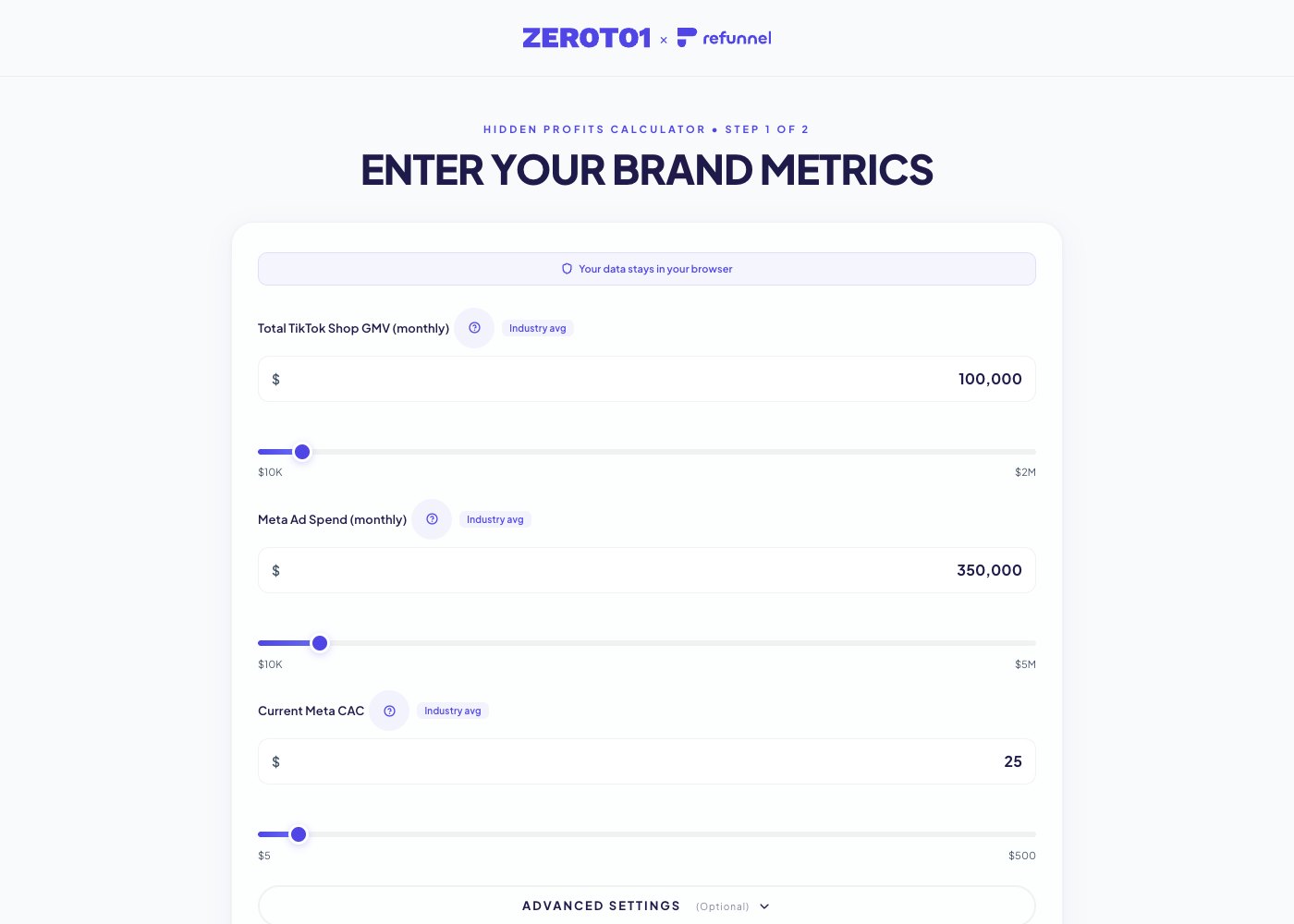
Or start with the envelope math. We built it into a free tool, the Hidden Profits Calculator. Put in your numbers and it sizes your halo, your Meta lift, and your content savings in a few minutes.
The Meta flywheel
The halo is the demand you did not attribute. The Meta flywheel is the asset you did not invoice: every month a run TikTok Shop program produces hundreds of creator videos, and the best of them are the highest-performing ad creative most brands will ever get access to.
The reason is structural. Meta's ranking systems reward creative diversity, many distinct faces, hooks, formats, and angles, and an account spending millions a month burns through creative fast. No channel feeds that appetite better than a recruited creator base posting thousands of videos a month. A studio cannot shoot that diversity. A UGC shop cannot brief it.
The flywheel itself is four steps. Recruit creators into TikTok Shop. Prove them: GMV per video picks the winners. License the winners, with rights cleared at post time. Then partner ads: proven creator, real Meta budget. Most brands skip the second step, and the second step is the entire point. TikTok Shop tells you what will scale on Meta before you pay a dollar to distribute it. It is a testing budget someone else already funded with purchases.
Here is what that looks like in practice. We took Ultra Pouches from a standing start to seven figures in TikTok Shop GMV in eight months. Their Meta account, run by a specialist paid agency, was an eight-figure account with nearly twenty thousand lifetime ads. Our top TikTok Shop creator for the brand was Curtis Martin, a welder with 17,600 followers, recruited in March: over two hundred videos and six figures in shop GMV. In May he posted a greenscreen react to Ultra's Joe Rogan feature with his own discount code on screen. No brief, no shoot, no edit bay. It ran to millions of views and five figures in GMV on zero media spend, and the shop flagged it as a winner inside 48 hours.
Thirteen days after that post, Curtis was live in the brand's Meta account. The largest single ad built on his content has run a half-million dollars in spend and reached over ten million people, from his page, not the brand's. His face, his page, their budget. His content is the number one creator ad in the account and the number two ad overall, lifetime. Whitelisted creators now carry a quarter of the account's lifetime spend. Fifty-six days from his first sample shipping to a half-million-dollar ad, live.
Here is the detail that gives this playbook its name. When we first pulled the account, none of this was labeled. The creator ads carried no naming convention, and the credit was flowing to another agency by default. We found Curtis by cross-referencing the Meta ads data against our creator CRM, matching names and outreach dates until the trail led back to a sample we shipped in March. The number two ad in an eight-figure account was hidden profit even to the people who built it. If nobody tags the pipeline, nobody gets credit for it, and nobody funds more of it.
Nobody picks a welder off a media kit, either. Ultra had not identified the blue-collar archetype. We found it by testing creator cohorts in the paid program, watched it convert, and concentrated on it. The sales picked Curtis, and then the system went looking for more of him. That is why the flywheel repeats: the paid team stops testing and starts scaling what already sold.
Running it takes discipline, not luck. License for real: Spark authorization on TikTok is not usage rights for paid social, so everything that goes to Meta carries an explicit usage rights grant with a date on it. Flight on a cadence and review monthly: we learned this on the same account, where weekly pre-vetting of every video stalled the whole pipeline, until a standing weekly flight with a monthly review of what ran replaced it. Volume is the strategy. Brief for both platforms from the first content challenge: the only thing that disqualifies a TikTok video from Meta is a TikTok-specific call to action, so briefs are built around rewards and format, never platform mechanics. Tag every creator-sourced ad by name, so month-end reporting on what the pipeline drove is a filter, not forensics. And close the loop: when a creator video enters the account's top ads, that hook, format, and archetype feed the next brief and the next sourcing filter, so the next Curtis is found on purpose.
We run this as a three-gate track on every enterprise engagement: the first licensed creator ad live in the brand's Meta account by channel activation, ten or more videos meeting the Meta buyer's own benchmarks by roughly month five, and by month nine, TikTok Shop creative as the top-performing ad type in the account, with fifty-plus licensed videos delivering a month. The brand's Meta agency keeps their seat. We make their best creative.
And the same library keeps paying past the ad account. Community content has become clients' best-performing email in a quarter and gone onto site and retail pages, produced in days, at no production cost, from relationships the program already owned.
Add it up
This is why the enterprise pitch anchors against awareness budgets, not performance budgets. OOH and CTV buy impressions and stop there. TikTok Shop buys impressions that sell product directly, lift every other channel you sell through, and manufacture the creative that makes your Meta spend work harder. Our longest-running client said it in one sentence, in their own words:
"We've been working with the team for several years now and have seen incredible results on TikTok Shop, with measurable halo effects on Amazon, Walmart.com, and across our retail footprint."
The shop GMV in your dashboard is the visible third of the return. To size the other two thirds for your brand, run your numbers through the calculator: your halo, your Meta lift, and your content engine savings, in about five minutes.